SMART SORTING: Development of advanced digital technologies in computer vision, artificial intelligence, and robotics for application in the automation of post-consumer
sorting processes in the textile,
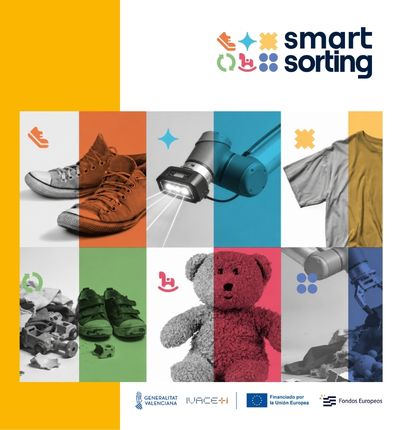 footwear, and toy sectors
Problem to be solved
In the textile, footwear, and childcare product sectors, the automation of industrial processes remains limited due to the physical and structural complexity of the products. Flexible, deformable, or low-rigidity materials make robotic handling difficult, reducing the efficiency of automated systems.
In addition, industrial environments often involve unstructured scenarios in which products appear mixed, overlapping, or deformed, making their detection, segmentation, and identification challenging for traditional systems.
This challenge is particularly evident in the field of post-consumer sorting, where waste arrives unsorted and exhibits a high diversity of materials and conditions. Currently, this process is carried out mainly manually or through semi-automated systems, which limits both efficiency and scalability.
At the European level, a significant proportion of small electrical and electronic devices are either disposed of incorrectly or remain stored in households. Up to 1.4 kg per inhabitant ends up in household waste each year, while approximately 5 kg of electronic devices per person remain accumulated in homes. This situation is especially relevant in toys and childcare products containing electrical or electronic components, resulting in the loss of valuable raw materials and highlighting the need for advanced technological solutions for their identification, classification, and valorization within the circular economy.
Objectives
The main objective of the SMART SORTING project is to develop and integrate advanced digital technologies that enable the automated classification of post-consumer products through intelligent perception systems and robotic manipulation.
The project focuses on the development of advanced digital technologies in computer vision, artificial intelligence, and robotics for application in the automation of post-consumer sorting processes in the textile, footwear, and toy sectors. Its aim is to improve the identification, segmentation, and manipulation of products in complex and unstructured environments, strengthening the technological capabilities required for industrial implementation within the framework of Industry 4.0 and the transition toward more sustainable models.
Specific Objectives
- Develop advanced computer vision algorithms for product detection and identification.
- Generate intelligent bin-picking strategies adapted to post-consumer waste streams.
- Design robotic systems and end-effectors for handling deformable, rigid, heterogeneous, and multi-material products.
- Integrate the developed technologies into functional prototypes adapted to real industrial environments.
- Assess the technological, environmental, and economic impact of the solutions developed.
- Validate the applicability of classified materials within circular economy models.
File and execution period
Project Reference Number: IMIDSA/2026/38
Start Date: April 1, 2026
Duration: 21 months
Status: Ongoing
Grant Amount: €194,612
COORDINATION CONTACT
Name: Dioni Cartagena
Telephone: +34 96 555 4475
Email: dionicartagena@aiju.es
Developed by:


Collaborating companies:







Related SDGs

Project funded by the European Union through the European Regional Development Fund (ERDF), within the framework of the call for grants aimed at technology centers in the Valencian Community for the development of non-economic R&D projects in STEP domains, corresponding to the 2026 funding period.