 DAEDALUS: advanced 4D biomaterials for the treatment of intestinal di
Problem to be solved
DAEDALUS is a European research and innovation project aimed at developing advanced biomaterials for healthcare applications. The project is aligned with European priorities related to health innovation, regenerative medicine, the circular economy, and the safe and sustainable development of new materials.
Through a Safe and Sustainable by Design approach — SSbD — DAEDALUS will combine synthetic and natural materials, including materials derived from waste sources, while assessing their safety, environmental sustainability, and suitability for future clinical use.
The consortium brings together universities, research centres, hospitals, technology companies, biomaterials specialists, healthcare professionals, and experts in sustainability, regulation, and social sciences.
Objectives
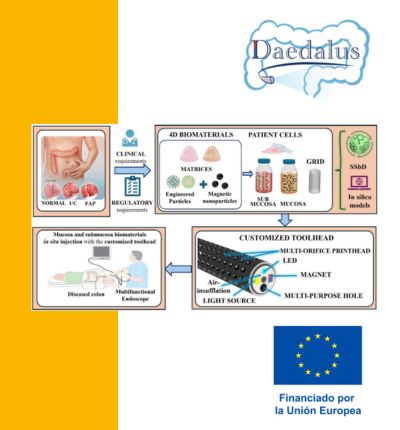
The overall objective of DAEDALUS is to develop a minimally invasive alternative to proctocolectomy for the treatment of colorectal diseases, particularly ulcerative colitis and familial adenomatous polyposis.
To achieve this, the project will develop two advanced 4D composite biomaterials designed to support the regeneration of the colorectal mucosa and submucosa. These biomaterials will be applied directly to the affected tissue using a multifunctional endoscope specifically designed for their in situ printing, crosslinking, and activation.
Specific objectives
• Develop 4D biomaterials capable of reproducing the properties and structure of the intestinal mucosa and submucosa.
• Incorporate smart particles for the controlled release of oxygen, glucose, growth factors, and antibacterial and antifibrotic agents.
• Enable the biomaterials to respond to magnetic, light, and thermal stimuli and adopt a structure similar to that of native intestinal tissue.
• Design a multifunctional toolhead compatible with commercial endoscopes to deposit, activate, and stabilise the biomaterials directly at the treatment site.
• Use in silico modelling tools to accelerate the design and optimisation of the materials while reducing resource use, development time, and material waste.
• Assess the safety, biocompatibility, and efficacy of the solution through in vitro, ex vivo, and in vivo testing.
• Scale up manufacturing processes and prepare the technology for future clinical, regulatory, and industrial translation.
• Analyse the environmental sustainability, economic feasibility, and social acceptance of the solution among patients, citizens, and healthcare professionals.
Tasks performed
AIJU leads the work package dedicated to sustainability and the business case, which aims to integrate societal and patient needs into the development of the DAEDALUS solution.
AIJU’s contribution will focus on:
• Identifying the needs, expectations, and concerns of patients and citizens regarding the new biomaterials and the proposed medical procedure.
• Conducting studies on the perception, social acceptance, and potential impact of the DAEDALUS solution.
• Gathering information through questionnaires and participatory activities involving citizens and patients in the countries represented in the project.
• Incorporating the results of these studies into the development process to promote a people-centred solution.
• Contributing to the assessment of sustainability, feasibility, and the technology’s future market introduction.
• Preparing a training plan and educational materials for citizens, patients, and other stakeholder groups.
• Periodically organising webinars, workshops, and training sessions for patients, citizens, researchers, biomedical professionals, and healthcare staff.
• Producing the DAEDALUS public didactic guidelines to facilitate understanding of 4D biomaterials and their potential healthcare applications.
Achieved objectives
DAEDALUS aims to provide a solution capable of regenerating damaged colorectal tissues while preserving, as far as possible, the functionality of the colon and rectum.
In the long term, the technology developed could:
• Reduce the need for highly invasive surgical procedures.
• Decrease the complications and adverse effects associated with proctocolectomy.
• Improve the quality of life of people affected by colorectal diseases.
• Support more personalised and patient-centred treatments.
• Open up new opportunities for the application of 4D biomaterials and bioprinting techniques in other organs and endoscopic procedures.
• Strengthen Europe’s capacity to research, manufacture, and commercialise advanced biomaterials for healthcare.
File and execution period
File number:101178568
Start date: 01/06/2025
Duration: 48 months
Status: In progress
Subsidized amount: 261.750,15 €
COORDINATOR CONTACT
Name: Pablo Busó
Telephone: 965554475
E-mail: pablobuso@aiju.es
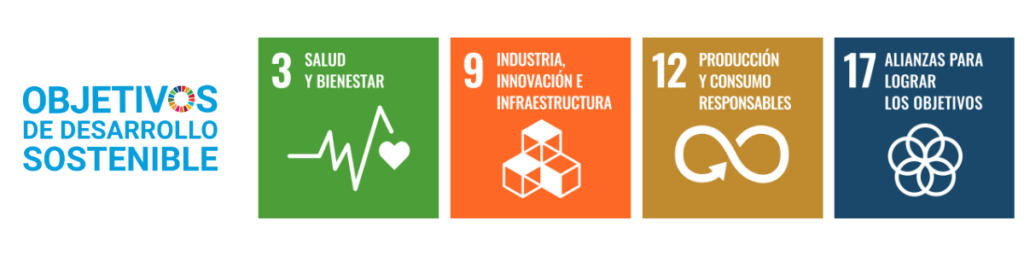
Related SDGs
Funded by the European Union. Views and opinions expressed are however those of the author(s) only and do not necessarily reflect those of the European Union or the European Health and Digital Executive Agency (HADEA). Neither the European Union nor the granting authority can be held responsible for them.” G.A. 101178568