BIO-ALC: new circular materials from agroforestry residues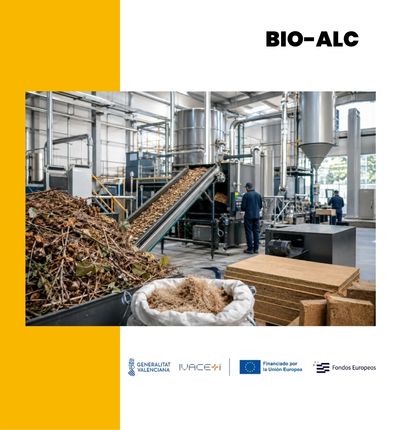
The BIO-ALC project, driven by AIJU, AITEX, and INESCOP, aims to transform agroforestry residues into advanced biobased materials for sectors such as packaging, textiles, toys, automotive, and footwear. In doing so, it promotes the circular economy while reducing dependence on fossil-based raw materials.
The transition towards a more sustainable economy requires making better use of the resources available within the region. In this context, BIO-ALC (Development of Advanced Circular Materials through the Valorization of Agroforestry Residues in the Valencian Community) has emerged as a project that will enable the conversion of agroforestry waste into new raw materials and high-value functional products through advanced biorefinery technologies.
Problem to be solved
Currently, a significant portion of agroforestry and pruning residues generated by agricultural, forestry, and green area maintenance activities is allocated to low-value applications such as composting, shredding, or energy recovery. However, these materials contain components with great potential to be transformed into new industrial raw materials.
This situation presents several challenges:
- Underutilization of locally available renewable resources.
- Dependence on imported fossil-based raw materials.
- Limited industrial valorization of agroforestry residues.
- The need to reduce emissions and move towards more sustainable production models.
- Growing demand for functional materials with a lower environmental impact.
BIO-ALC addresses these challenges through an advanced biorefinery model capable of transforming lignocellulosic residues into innovative and functional materials with real industrial applications.
General Objective
The main objective of BIO-ALC is to develop and validate, at pilot scale, an integrated lignocellulosic biomass valorization process based on clean selective fractionation technologies. The process will enable the extraction of functional fractions and their transformation into advanced biobased materials with enhanced properties and strong industrial implementation potential.
The project will support progress from Technology Readiness Level (TRL) 5 to TRL 7, validating technologies under conditions close to real industrial environments and facilitating their transfer to the Valencian business ecosystem.
Specific Objectives
- Identify, select, and condition suitable agroforestry residues for valorization.
- Develop an advanced biorefinery model focused on the circular economy.
- Obtain functional fractions with controlled and reproducible properties.
- Develop demonstrators of biobased materials with advanced functionalities.
- Validate the functional performance of the materials under real-use conditions.
- Assess industrial integration, scalability, and the substitution potential of fossil-based raw materials.
- Position the technology against conventional solutions through integrated validation.
File and execution period
Project Reference Number: IMIDSB/2026/18
Start Date: 01/04/2026
Duration: 21 meses
Status: Ongoing
Grant Amount: €160,915.55
COORDINATION CONTACT
Name: Enrique Añó
Telephone: +34 96 555 4475 (Ext. 309)
Email: enriqueanyo@aiju.es
Developed by:


Related SDGs

Project funded by the European Union through the European Regional Development Fund (ERDF), within the framework of the call for grants aimed at technology centers in the Valencian Community for the development of non-economic R&D projects in STEP areas, corresponding to the 2026 funding period.

Linked to the S3 smart specialization strategy line: Ecological and sustainable transition